
Perpustakaan UIN Jurai Siwo Lampung
Search Suggestions
Loading...
{{ item.text }}
Search History
{{ tmpObj[key].text }}
No. Panggil
625.7 Roe tKetersediaan
My Library
1/1Item Detail (1) - My Library
| Kode | No. Panggil | Lokasi | Status |
|---|---|---|---|
| 202315134 | 625.7 Roe t | My Library |
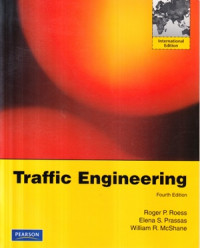
Traffic engineering
Deskripsi
The transportation system is often referred to as the nation's "lifeblood circulation system." Our complex system of roads and highways, railroads, airports and airlines, waterways, and urban transit systems provides for the movement of people and goods within and between our densest urban cities and the most remote outposts of the nation. Without the ability to travel and to transport goods, society must be structured around small self-sufficient communities, each of which produces food and material for all of its needs locally and disposes of its wastes in a similar manner. The benefits of economic specialization and mass production are possible only where transportation exists to move needed materials of production to centralized loca¬tions, and finished products to widely dispersed consumers.
Traffic engineering deals with one critical element of the transportation system: streets and highways, and their use by vehicles. This vast national system provides mobility and access for individuals in private autos and for goods in trucks of various sizes and forms, and facilitates public transport by supporting buses, bicycles, and pedestrians.
Because the transportation system is such a critical part of our public infrastructure, the traffic engineer is involved in a wide range of issues, often in a very public setting, and must bring a wide range of skills to the table to be effective. Traffic engineers must have an appreciation for and understanding of planning, design, management, construction, operation, control, and system optimization. All of these functions involve traffic engineers at some level.
This text focuses on the key engineering skills required to practice traffic engineering in a modern setting. This is the fourth edition of this textbook. It includes material on the lat¬est standards and criteria of the Manual on Uniform Traffic Control Devices (2003 Edition and forthcoming 2010 Edition), the Policy on Geometric Design of Highways and Streets (2004 Edition), the Highway Capacity Manual (2000 Edition and forthcoming 2010 Edition), and other critical
references. It also presents both fundamental theory and a broad range of applications to modern problems.
The text is organized in five major functional parts:
1. Part 1—Traffic Components and Characteristics
2. Part 2—Traffic Studies and Programs
3. Part 3—Freeways and Rural Highways
4. Part 4—The Intersection
5. Part 5—Arterials, Networks, and Systems
This text can be used for an undergraduate survey course, or for more detailed graduate courses. At Polytechnic Institute of New York University, it is used for two undergraduate courses and a series of three graduate courses.
As in previous editions, the text contains many sample problems and illustrations that can be used in conjunction with course material. A solutions manual is available. The authors hope that practicing professionals and students find this text useful and informative, and they invite comments and/or criti¬cisms that will help them continue to improve the material.
Traffic engineering deals with one critical element of the transportation system: streets and highways, and their use by vehicles. This vast national system provides mobility and access for individuals in private autos and for goods in trucks of various sizes and forms, and facilitates public transport by supporting buses, bicycles, and pedestrians.
Because the transportation system is such a critical part of our public infrastructure, the traffic engineer is involved in a wide range of issues, often in a very public setting, and must bring a wide range of skills to the table to be effective. Traffic engineers must have an appreciation for and understanding of planning, design, management, construction, operation, control, and system optimization. All of these functions involve traffic engineers at some level.
This text focuses on the key engineering skills required to practice traffic engineering in a modern setting. This is the fourth edition of this textbook. It includes material on the lat¬est standards and criteria of the Manual on Uniform Traffic Control Devices (2003 Edition and forthcoming 2010 Edition), the Policy on Geometric Design of Highways and Streets (2004 Edition), the Highway Capacity Manual (2000 Edition and forthcoming 2010 Edition), and other critical
references. It also presents both fundamental theory and a broad range of applications to modern problems.
The text is organized in five major functional parts:
1. Part 1—Traffic Components and Characteristics
2. Part 2—Traffic Studies and Programs
3. Part 3—Freeways and Rural Highways
4. Part 4—The Intersection
5. Part 5—Arterials, Networks, and Systems
This text can be used for an undergraduate survey course, or for more detailed graduate courses. At Polytechnic Institute of New York University, it is used for two undergraduate courses and a series of three graduate courses.
As in previous editions, the text contains many sample problems and illustrations that can be used in conjunction with course material. A solutions manual is available. The authors hope that practicing professionals and students find this text useful and informative, and they invite comments and/or criti¬cisms that will help them continue to improve the material.
Informasi Detail
- Penerbit
- London : Pearson., 2011
- Deskripsi Fisik
- 744 hal. : il. ; 25 cm.
- Bahasa
- English
- ISBN/ISSN
- 9780132076524
- Klasifikasi
- 625.7
- Subjek
Komentar
Anda harus masuk sebelum memberikan komentar