
Perpustakaan UIN Jurai Siwo Lampung
Search Suggestions
Loading...
{{ item.text }}
Search History
{{ tmpObj[key].text }}
No. Panggil
T 337 App i c.1U 337 App i c.2Ketersediaan
My Library
2/2Item Detail (2) - My Library
| Kode | No. Panggil | Lokasi | Status |
|---|---|---|---|
| 202309188 | T 337 App i c.1 | My Library | |
| 202309189 | U 337 App i c.2 | My Library |
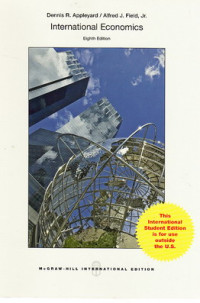
International economics
Deskripsi
It is our view that in a time of dramatic increase in globalization and high interrelatedness among coun¬tries, every student should have a conscious awareness of "things international." Whether one is studying, for example, political science, sociology, chemistry, art, history, or economics, developments worldwide impinge upon the subject matter of the chosen discipline. Such developments may take the form of the dis¬covery of a new compound in Germany, an election result in Greece, a new oil find in Mexico, formation of a new country in Africa, a startling new political/terrorist/military development in Pakistan or Syria, or a change in consumer tastes in China. And, because information now gets transmitted instantaneously across continents and oceans, scientists, governments, firms, and households all react quickly to new information by altering behavior in laboratories, clinics, legislative processes, production and marketing strategies, consumption and travel decisions, and research projects. Without keeping track of international develop¬ments, today's student will be unable to understand the changing nature of the world and the material that he or she is studying. .
In addition to perceiving the need for international awareness on the part of students in general, we think it is absolutely mandatory that students with an interest in economics recognize that international economic events and the international dimensions of the subject surround us every day. As we prepared to launch this eighth edition of International Economics, we could not help noting how much had changed since the initial writing for our first edition. The world has economically internationalized even faster than we anticipated more than 20 years ago, and the awareness of the role of international issues in our lives has increased substantially. Almost daily, headlines focus on developments such as the increased problems facing monetary union in Europe and the euro; proposed policies of erecting additional trade barriers as a protective response to worldwide economic weakness; increased integration efforts such as the emerging Trans-Pacific Partnership; and growing vocal opposition and hostility in many countries to the presence of large and increasing numbers of immigrants. Beyond these broad issues, headlines also trumpet news of the U.S. trade deficit, rising (or falling) gasoline prices, the value of the Chinese renminbi yuan, and outsourc¬ing to call centers in India. In addition, as we write this edition, the world has become painfully aware that increased globalization links countries together strongly in times both of recession and prosperity.
The growing awareness of the importance of international issues is also in evidence in increased stu¬dent interest in such issues, particularly those related to employment, international working conditions, and equity. It is thus increasingly important that individuals have a practical working knowledge of the economic fundamentals underlying international,actions to find their way through the myriad arguments, emotions, and statistics that bombard them almost daily. Young, budding economists need to be equipped with the framework, the tools, and the basic institutional knowledge that will permit them to make sense of the increasingly interdependent economic environment. Further, there will be few jobs that they will later pursue that will not have an international dimension, whether it be ordering components from a Brazilian firm, traveling to a trade show in Malaysia, making a loan for the transport of Caspian Sea oil, or working in an eftlbassy in Quito or in a medical mission in Burundi.
Thus, the motive for writing this edition is much the same as in earlier editions: to provide a clear and comprehensive text that will help students move beyond simple recognition and interest in international issues and toward a level of understanding of current and future international developments that will be of use to them in analyzing the problem at hand and selecting a policy position. In other words, we seek to help these scholars acquire the necessary human capital for dealing with important questions, for satisfying their intellectual curiosity, and for providing a foundation for future on-the-job decisions.
We have been very flattered by the favorable response to the previous seven editions of our book. In this eighth edition, we continue to build upon the well-received features to develop a text that is even more attuned to our objectives. We have also continued to attempt to clarify our presentation of some of the more difficult concepts and models in order to be more student-friendly.
In addition to perceiving the need for international awareness on the part of students in general, we think it is absolutely mandatory that students with an interest in economics recognize that international economic events and the international dimensions of the subject surround us every day. As we prepared to launch this eighth edition of International Economics, we could not help noting how much had changed since the initial writing for our first edition. The world has economically internationalized even faster than we anticipated more than 20 years ago, and the awareness of the role of international issues in our lives has increased substantially. Almost daily, headlines focus on developments such as the increased problems facing monetary union in Europe and the euro; proposed policies of erecting additional trade barriers as a protective response to worldwide economic weakness; increased integration efforts such as the emerging Trans-Pacific Partnership; and growing vocal opposition and hostility in many countries to the presence of large and increasing numbers of immigrants. Beyond these broad issues, headlines also trumpet news of the U.S. trade deficit, rising (or falling) gasoline prices, the value of the Chinese renminbi yuan, and outsourc¬ing to call centers in India. In addition, as we write this edition, the world has become painfully aware that increased globalization links countries together strongly in times both of recession and prosperity.
The growing awareness of the importance of international issues is also in evidence in increased stu¬dent interest in such issues, particularly those related to employment, international working conditions, and equity. It is thus increasingly important that individuals have a practical working knowledge of the economic fundamentals underlying international,actions to find their way through the myriad arguments, emotions, and statistics that bombard them almost daily. Young, budding economists need to be equipped with the framework, the tools, and the basic institutional knowledge that will permit them to make sense of the increasingly interdependent economic environment. Further, there will be few jobs that they will later pursue that will not have an international dimension, whether it be ordering components from a Brazilian firm, traveling to a trade show in Malaysia, making a loan for the transport of Caspian Sea oil, or working in an eftlbassy in Quito or in a medical mission in Burundi.
Thus, the motive for writing this edition is much the same as in earlier editions: to provide a clear and comprehensive text that will help students move beyond simple recognition and interest in international issues and toward a level of understanding of current and future international developments that will be of use to them in analyzing the problem at hand and selecting a policy position. In other words, we seek to help these scholars acquire the necessary human capital for dealing with important questions, for satisfying their intellectual curiosity, and for providing a foundation for future on-the-job decisions.
We have been very flattered by the favorable response to the previous seven editions of our book. In this eighth edition, we continue to build upon the well-received features to develop a text that is even more attuned to our objectives. We have also continued to attempt to clarify our presentation of some of the more difficult concepts and models in order to be more student-friendly.
Informasi Detail
- Penerbit
- New York : Mc Graw-Hill., 2014
- Deskripsi Fisik
- xxiv, 824 hal. il. ; 25 cm.
- Bahasa
- English
- ISBN/ISSN
- 9781259010576
- Klasifikasi
- 337
- Subjek
Komentar
Anda harus masuk sebelum memberikan komentar